

If you have shopped in Japan before, forget what you know. Since 1 November 2026, tax-free shopping works the other way round. You no longer get the tax taken off at the till. You pay the full price, then claim the tax back when you leave the country.
Here is how the new system works, step by step, and the mistakes that can cost you the whole refund.
What changed
Until 31 October, shops took the consumption tax off the price at the register once they had checked your passport. For food, drinks and cosmetics, your purchases also had to go into sealed bags. All of that is gone.
What counts is the day you buy, not the day you fly. Purchases made on or after 1 November follow the new refund system. Purchases made before 1 November follow the old rules.
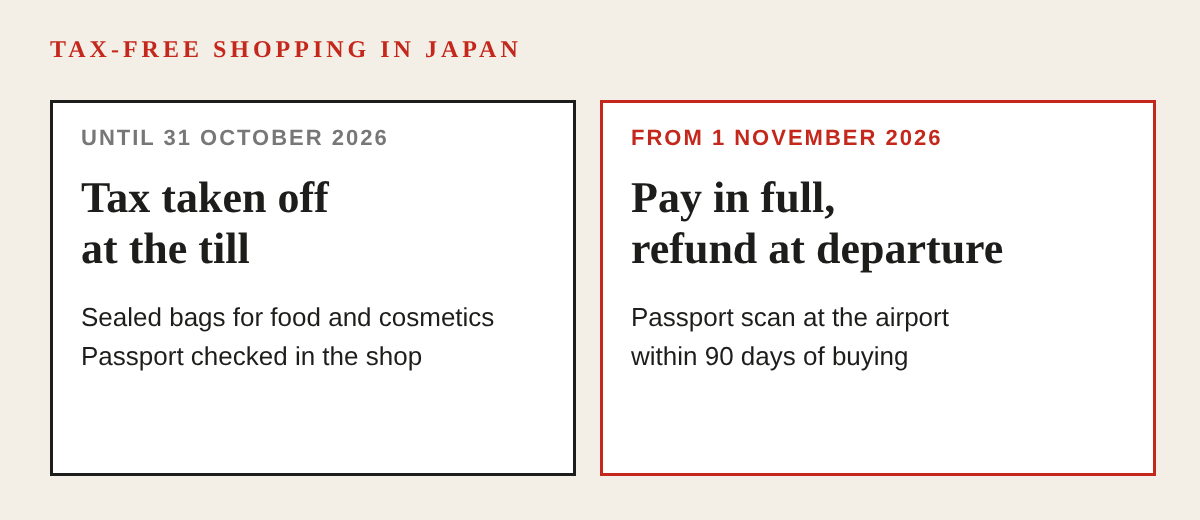
Diagram: based on Japan Customs, Tax Exemption (Refund) Program for Foreign Visitors
The six steps
Spend at least ¥5,000 before tax at one tax-free shop in one day. This minimum has not changed.
Pay the full, tax-included price. Keep every receipt with the items it covers.
Keep the goods unopened and carry them out of Japan yourself. Gold and platinum bullion and items that are already exempt from consumption tax are not covered.
Within 90 days of buying, scan your passport at a tax-free procedure terminal in the international departure area, before you check in your bags. At Narita, Haneda, Kansai, Chubu, Fukuoka, New Chitose and Naha, you can also do this online through Visit Japan Web, using the airport Wi-Fi before security. Set up Visit Japan Web before you travel.
The terminal shows a Green or a Red result. Green means you are finished. Red means you take your purchases to the customs inspection area.
After customs confirms the goods are leaving Japan, the shop or its refund service pays you back.
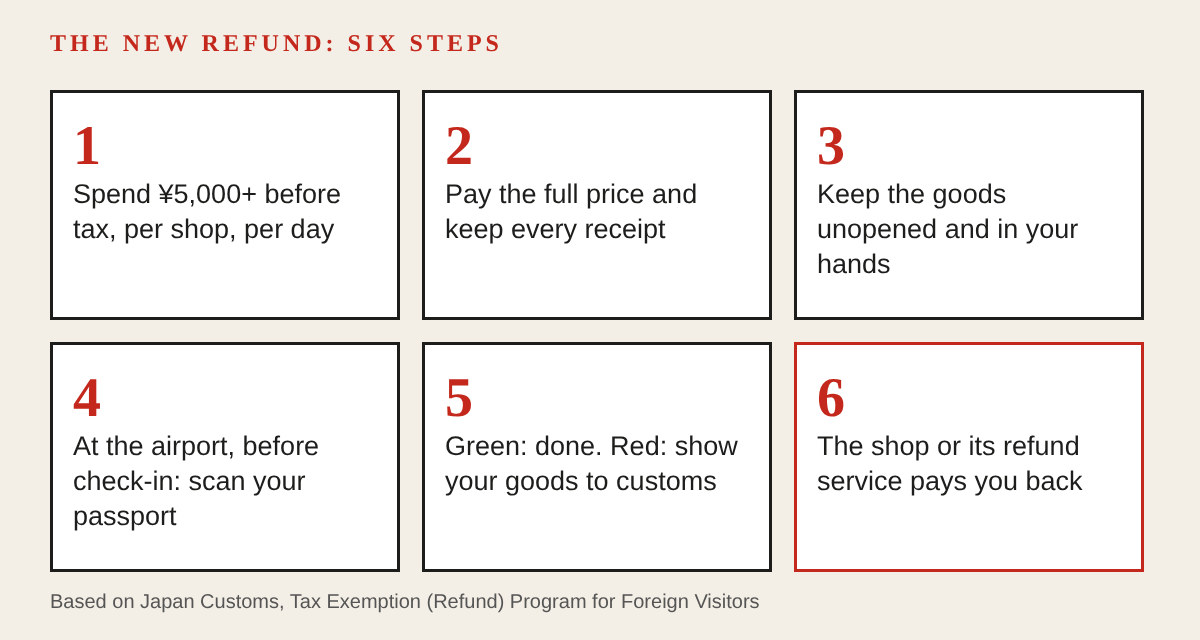
Diagram: based on Japan Customs, Tax Exemption (Refund) Program for Foreign Visitors
The rules that can cost you the whole refund
Refunds work receipt by receipt. If one item on a receipt is missing at customs, nothing on that receipt qualifies.
Do not eat, drink or use consumables before you leave. One snack eaten from a bag can void that whole receipt. Ask the shop to put food and non-food on separate receipts.
Your tax-free items must be with you at the terminal. Once your checked bag goes to the airline, you cannot get it back for the procedure. Carry them in your hand luggage or do the procedure before you check in.
Do the procedure at your final departure point from Japan. This includes connections from a domestic flight to an international one.
Leave Japan promptly after inspection. If you do not export the goods, you can be asked to pay the refund back, and there can be penalties.
Some shops may still look for an entry stamp in your passport. If you used an automated gate, ask an immigration officer for a stamp.
How the money comes back
This is the part that depends on the shop. The refund is the consumption tax on your receipt: 10 percent, or 8 percent for food and non-alcoholic drinks. On a ¥11,000 receipt that is ¥1,000. On ¥110,000 it is ¥10,000, before any fees.
The shop or a refund service pays it out after customs confirms your goods. The method can be a refund to your credit card, an app, a bank transfer, or cash at the departure port. There is no single rule on who pays the refund service’s fee, so the amount you receive can be lower than the tax you paid.
Before you pay, ask three things: how will I be refunded, is there a fee, and how long does it take. Paying by credit card keeps things simple, because the refund can go back to the same card.
At the airport
Arrive earlier than usual. Airports expect queues at the terminals.
Bring your passport, all receipts, every item you bought and your boarding documents.
Finish the procedure before you board. If you miss your flight because it took too long, neither customs nor the airline will compensate you.
Your checklist
Buy from a shop that offers the refund system, and ask how the refund is paid.
Ask for separate receipts for food and non-food.
Keep everything unopened and keep the receipts together.
Scan your passport at the terminal before you check in your bags.
Want all of this in one printable PDF, with worked examples and the Japanese phrases to show staff? Get the Japan Tax-Free Refund Guide (5 pages, $12).
Last checked on 4 November 2026.
Kaz